
What school looks like once you’re out there — routines, resources and the bits nobody warns you about.
Meg Wedding, @kindrednomad
When we set out, we treated life as a bit of a holiday for a little too long. We’d both left demanding jobs, and we honestly just enjoyed the break in routine and the freedom to roam without commitments.
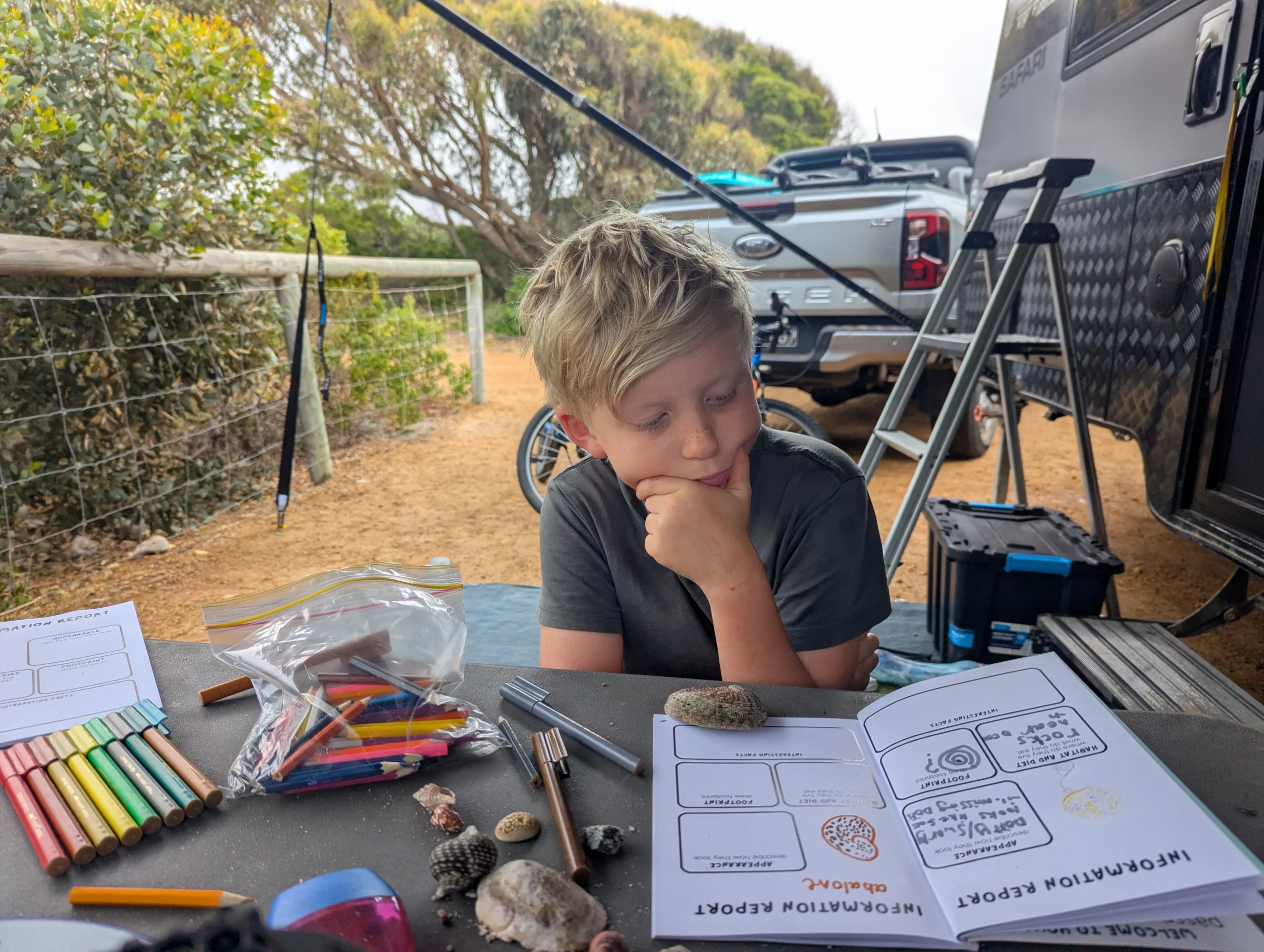
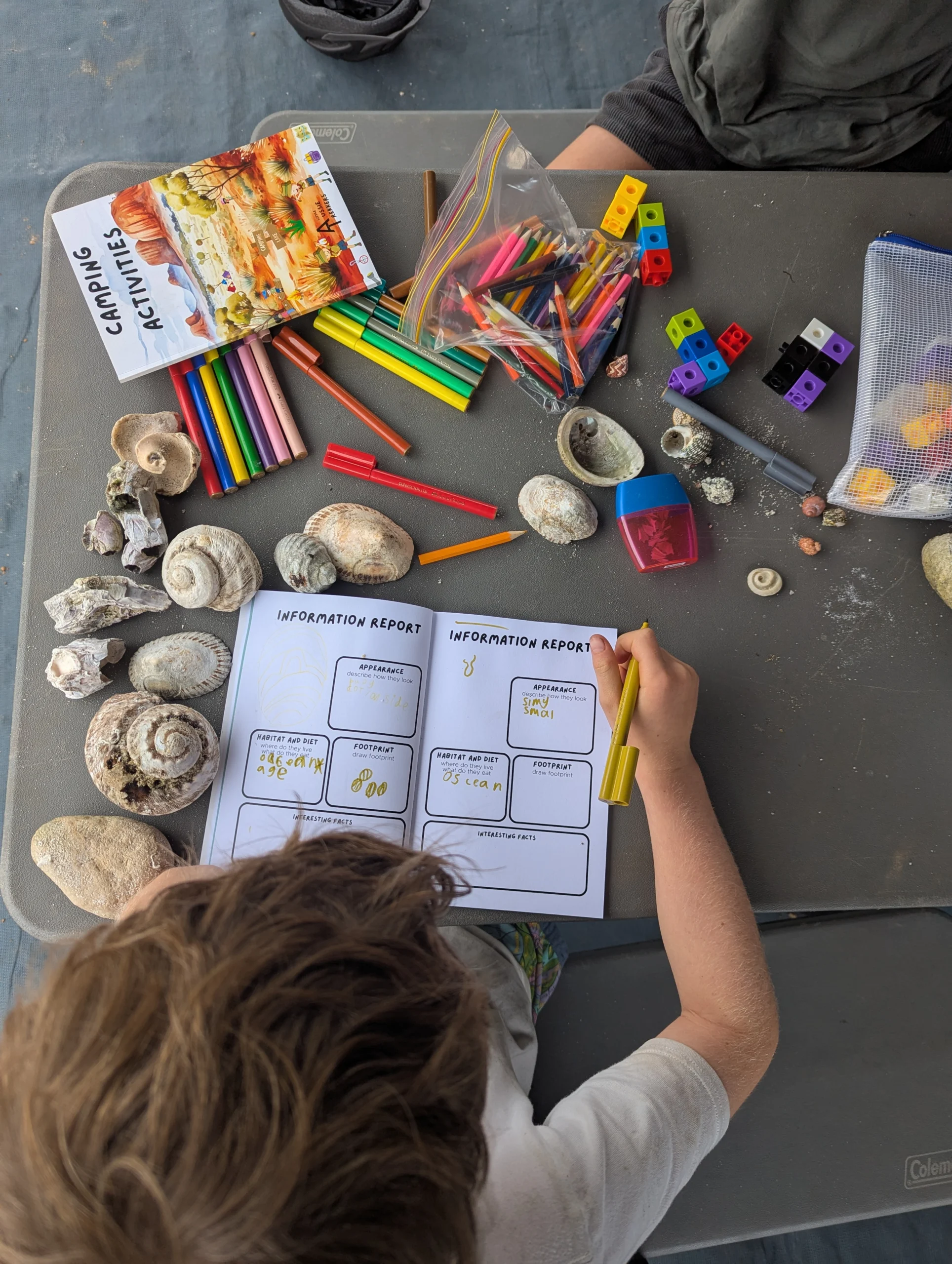
Then it dawned on us that we needed to get more serious about the schooling side of things, daunting as that felt. We asked everyone we met along the way what they were doing, and nothing quite gelled for us. Meanwhile our boys were out learning to tie hooks onto fishing line, building fish traps in the sand and generally living their best lives. We didn’t want to tie them to a schedule every morning, all of us fighting each other inside while the best of the weather went to waste outside.
What’s on this page
- Start by getting the kids on side
- Keep an eye on the basics, then weave them in
- Two learning spaces, and a hand-up rule
- We didn’t school every day — not in the conventional sense
- How much time does it actually take?
- What families actually use
- Get them a journal
- The classroom is wherever you want it to be
- Coming home
- And if it isn’t working
Start by getting the kids on side
Keep an eye on the basics, then weave them in
Know which basics need to be covered, then work those opportunities into your travels.
We had two whiteboards for the boys in the car and would set them challenges as we drove. They usually revolved around lolly calculations… sometimes fuel and distances.
Then tie in the visits: museums, historical sites, the traditional owners of wherever you’re heading. Learn about the town. Who lives there? What do they do for a living? How has it changed over time? It can all be woven into their learning, and sometimes you’ll be lucky enough that they don’t even realise it.
Two learning spaces, and a hand-up rule
If you’re managing multiple children doing structured learning, we found it helped to keep them in separate spaces so they don’t distract each other.
If you can divide and conquer, even better. But if you’re managing on your own, agree on a signal they can use (putting a hand up works), so you can switch between them. We also kept fidgets and activities on hand so one could keep going while we were busy helping the other.
We didn’t school every day — not in the conventional sense
Every day there’s an opportunity to learn something, and it’s not always from a book. Visitor centres, museums, historical sites, art galleries.
Other families describe the same thing:
Today on our drive around the Flinders ranges we studied geology, with the geological time line drive, built rock towers which is geometry, explored ruins for the 1860s which is Australian history and the effects of drought, discussed the changing vegetation and rock formations, and then come back to camp so the kids can play inside a burnt out tree trunk that they’ve turned into a cubby before sitting around a camp fire. Tonight they’ll write diaries, send emails, and go to bed to read books or kindles. You don’t get that type of education in school.
Sitting by the camp fire, looking at the stars is science, camp fire safety is a life skill.
We do read about and study relevant topics to the locations we are going to or traveling through. Eg before tassie we studied world exploration through to first fleet so we could then be ready for convicts when we got there. In Victoria you can travel the areas of Ned Kelly, we have read books on various inland explorers whilst traveling their major highways, collected rocks and minerals, bones and more for a museum at home.
How much time does it actually take?
It’s really up to each family and how you work together, but the families who wrote to us tend to land somewhere between one and two hours on a working day:
Grade 4 is spelling and times tables daily, maths daily, handwriting, grammar and comprehension (2 pages/week each), travel journal. Grade 1 is reading, phonics (3pgs/day) maths (3-4pgs/day) and a travel journal. We get it done in about 1.5 hrs each morning.
The work we did everyday depended on how we all felt, if the boys were working well we did more (approx 1.5 hours).
We homeschool. We do the alternate Steiner curriculum. I find it gentle but effective. We don’t stress, it’s a nice bonding experience. It’s an hour or two a day 3 times a week.
I plan to sit with each one individually for around 30 – 60 mins each wk day morning for Maths and English.
One family on Distance Education pointed out something in the fine print worth knowing:
The sign off sheet aims for 4 hours of work per day BUT the fine print makes it clear that excursions are included! So for example this week we have done about 2 hours in the morning, then explored lighthouses, beaches with stingrays, wineries and rivers.
Others front-load it around the driving:
Boys do most of work in the car travelling so we are free when we get to camp.
We stop at freebies from Sunday to Thursday to home school for 3 full days then travel a bit on the Thursday and Friday.
What families actually use
Pulled from what TAWKers have told us over the years:
Online programs
Maths Playground, Spellodrome, Reading Eggs, Maths Online, Studyladder, Spelling City. Worth asking about homeschool discounts; several families mentioned getting one.
Reading
Kindles, because they’re compact. Libby or BorrowBox for books and audiobooks on the road. And libraries as you pass through, both for borrowing and for a bit of downtime in air conditioning.
Audio
Long stretches of highway are made for audiobooks. There are plenty to consider, but our all-time favourite was Jack and Harry, an Australian outback adventure novel by Tony McKenna and Mervyn Davis, narrated by David Tredinnick.
The places themselves
A lot of well-known landmarks have kids’ activity sheets available, and visitor centre brochures are free curriculum. One family said even their old Camps guide became a learning tool.
Google and Google Earth
For checking the topography of wherever you’ve pitched up. “What’s that? Google it.”
Get them a journal
Most teachers encourage it, and ours did. We should have been stricter about it, and looking back, it would have been such an amazing memento if the boys had kept it up consistently.
There are other options online too, like Polarsteps, where family and friends can follow along with your travels.
The classroom is wherever you want it to be
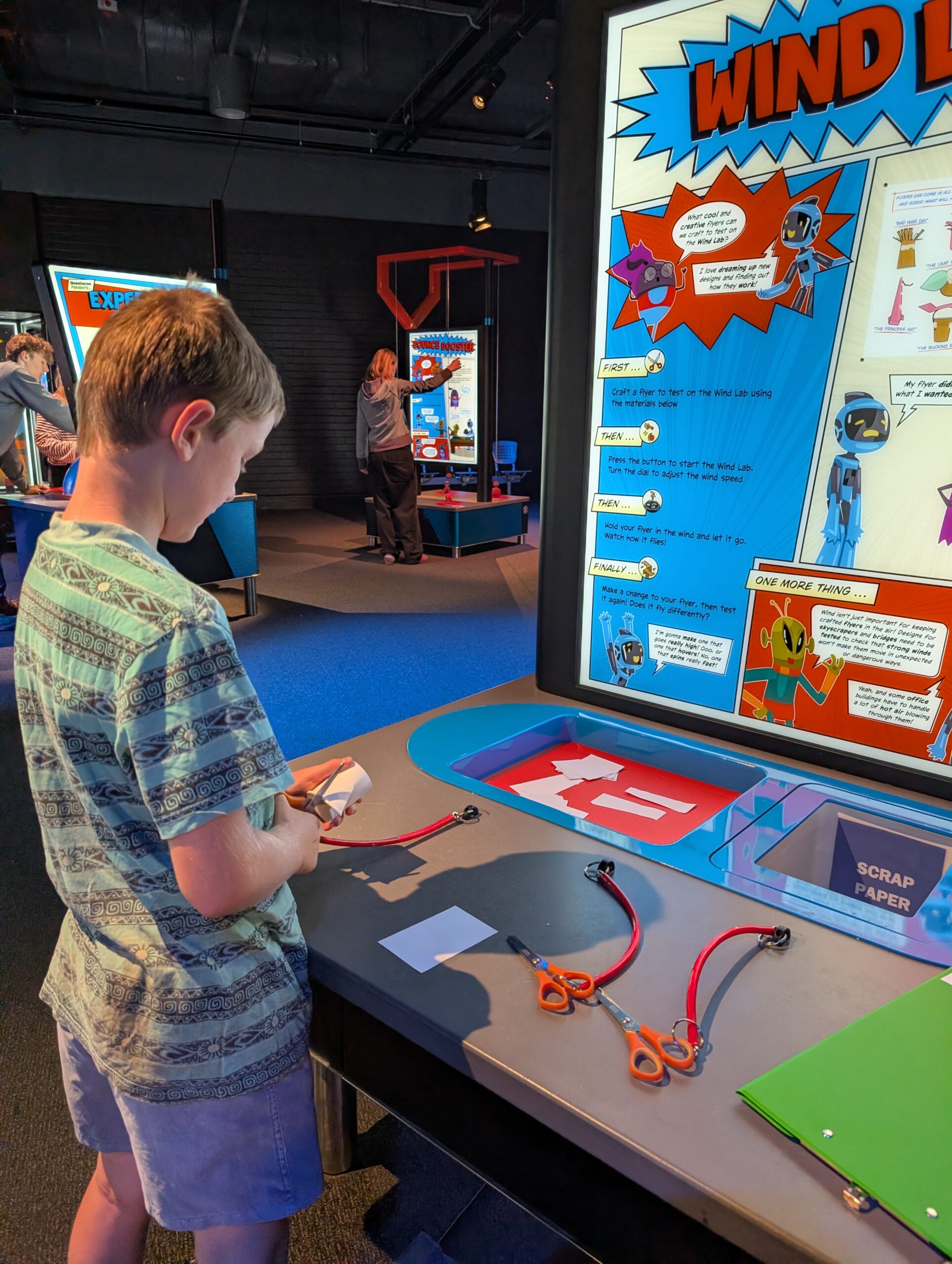
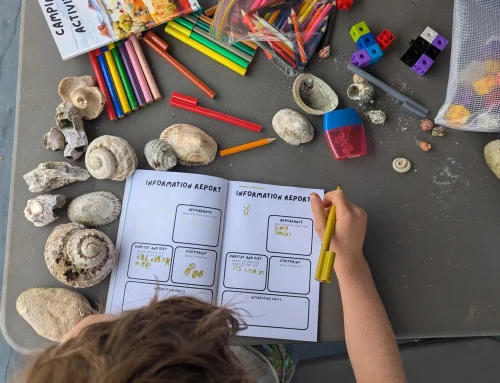
We asked our TAWKers to show us their kids learning on the road, and the photos told the story better than we could. Outside art classes. Flora and fauna at Walpole. Geology at the Super Pit. The Rabbit Proof Fence. The National Library. Museums, Australia Zoo, snorkelling the Great Barrier Reef.
They’re not sitting in a classroom reading about these things. They’re standing in them. They’re on a school excursion every single day.
Honestly, we’ve never quite understood why it’s made so hard for families to take their kids out of school and travel this country for a while. You’d think it would be encouraged.
Coming home
We won’t lie… this was the part that worried us most.
But our two boys have slotted straight back into school. There’s some extra work to make sure they’re on track with what their classrooms are doing, and they’re doing well.
We’d recommend speaking to the school before they go back, then checking in again once they’ve settled.
One family who did three years of Distance Education put it best:
Now we are back in regular schools I am very grateful for the DE experience. It’s like childbirth — a pain in the neck at the time, but worth it in the end.
And if it isn’t working
It’s worth saying this out loud, because plenty of families have been through it and assumed they were the only ones.
We started term 2 last year and immediately felt exhausted by it all. We lasted 5 weeks before I threw a tanty and told the teacher I’d had enough. He was more than happy to comply.
The first year nearly ended in divorce and we were ready to sell the van and go back to the suburbs.
This year we started off with a bit more work again but it’s all gone a bit pear shaped cos quite frankly, I’m over it and fighting with the kids… I have already spoken to their teacher about dropping some work and she was fine. I think you’ll find they will be receptive to what you’d like.
Several families stopped for a term, worked, and put the kids into a local school for a stretch, then picked the travelling back up. That’s not failure. That’s just finding the thing that works.

 for Aussie families